
When it comes to buying latex clothing, this unique material has its own set of Dos and Don’ts for finding the right items, then dressing into and caring for them properly. This might be daunting for someone who has never bought it before, but you will see that all designers offer fundamentally the same advice, and it can be boiled down to a few key points.
So allow us to dust off the arcane grimoire of latex clothing, and reveal some of its wisdom. You’ll see it’s not so scary after all!
1. Mind your material: Latex vs Latex-look
This site is all about real latex, whereas most clothing labelled “latex” by the media is not in fact latex but a plastic-based compound. Are you positive the clothing you want is real latex, which is to say natural rubber?
Earlier this year, Beyoncé launched a new collection of her Ivy Park clothing line. The glossy caramel designs were advertised everywhere as “latex”, even on the official Adidas store. However, dig a little into the product page and it specified the clothing was “100% polyurethane film”.
Let this serve as a warning: Ensure the store you’re buying from specialises in actual latex. Check the product details for material composition, and accept no less than 100% natural rubber/latex. Do not rely on the item name!
For a discussion on the differences between real latex and faux latex, see our Introduction to Latex. We will continue on the assumption that you understand the distinction, and are certain you want to buy the genuine article.
2. Start small
The smart consensus is to start small and basic.
- Underwear/lingerie, such as knickers, boxer shorts, tights/stockings.
- Small accessories, such as gloves, socks.
- Basic separates: leggings, t-shirts, simple skirts and tops
Smaller items are cheaper and therefore a good test to see whether you enjoy the feel of latex, not to mention the whole process of dressing into and caring for it.
Smaller items and separates are easier to put on, allowing you to become a pro at slipping into rubber before you get that bigger, expensive item. They are easier to wash and care for, and if you make a mistake such as discolouring the garment or tearing it, it will not be so much money down the drain.
Latex can be uncomfortable if worn without the right amount of dressing aid applied to the right places; the more surface area of your body the latex covers, the more potential areas of discomfort. Smaller items are therefore a good way to practice dressing into latex properly and wearing it for longer.
Tip: Underwear is perfect for wearing under everyday clothing or as sleepwear. Both of these situations allow wearing latex for a greater part of the day, so you can get used to keeping it on for longer without discomfort.
3. Where to buy latex clothing
To name just a few of the biggest latex companies offering quality yet affordable basics: Libidex (UK), Blackstyle (Germany), Bright&Shiny (Ukraine), and Polymorph (Canada) are all trusted brands.
The choice is much wider than this though, with hundreds of small companies and individual artisans making latex. Any site listed in our A-Z or Latex Clothing Search is an authentic latex provider, and you can also search Etsy and look for customer reviews.
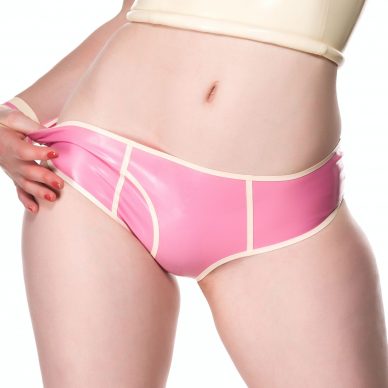

L: Y-Fronts by Westward Bound • R: Boxer Shorts by Honour
So who are the sellers you should be wary of? Wish.com, China-based wholesalers such as Alibaba or Milanoo, and drop shippers from non-label eBay stores*. It’s tempting to try these because they are cheaper, but when you buy from such sites there is no guarantee which factory the latex is sourced from, and even the product images may be false or stolen. Some buyers may have a good experience, other buyers a terrible one: it’s a lottery.
We are not totally against buying latex from these sites, but it should be when you already have a baseline for what quality latex is supposed to look and feel like. The worst thing would be for a first-time buyer to get something from these stores and be sorely disappointed at its quality, and then to believe that it’s representative of all latex. The first encounter should be with trusted latex. It may be a bit more expensive, but there is a much greater chance you’ll fall in love with it.
And what about cheap and cheerful sex-shop rubber? Well, first of all, make sure the material composition is indeed latex/rubber because some stores are prone to the “latex vs. latex-look” confusion. Secondly, the latex quality depends on the manufacturer: Latexa, Denber Rubber, and Fetisso are examples of reliable labels. If you can’t identify the wholesaler, then the quality may once again prove to be a lottery. Proceed with caution!
It sounds like a cliché, but you get what you pay for with latex.
*It is possible to find good deals on eBay, but ensure the garment has a label from a recognised latex brand.
4. Before you buy: options & extras
So you’ve found a store and picked what item you want to buy.
It’s crucial to measure yourself correctly: here we advise you to follow the guidance on the designer’s website. They will have a dedicated page for this, and each maker creates garments according to their own standard, so follow their size chart. If you fall between sizes, ask the store for advice or consider a made to measure service. Latex does stretch, but designers already account for this in their measurements, that’s why you should always aim for an accurate fit.
Before checkout, you may be presented with several options for customisation, alongside the usual Size and Colour options:
Thickness — 0.4mm is the standard; thinner than this can be good for very light and dainty lingerie; thicker may be good for outerwear like jeans & jackets if you want them to have a heavier, more rigid shape.
Chlorination — This is a chemical treatment to make the latex less frictive and much easier to dress into. So easy, in fact, that you won’t need any dressing aid. Latex loses some of its shine after undergoing the chlorination process.
Zips, attachments, etc. — It’s beyond the remit of this article for us to meticulously lay out the pros and cons of a crotch zipper. Suffice to say, options exist. If you’re not presented with your desired ones on the product page, another vendor will likely offer a similar item with the additions you need. Failing that, contact the designer directly and get it custom made — for an appropriate surcharge, of course.
Welcome to the world of latex: where you are limited only by your imagination! (and your bank balance).

5. Shiner & dressing aid
Shiner, dressing aid, and special formulas for washing latex — do you need any of that stuff when starting out?
The minimum requirement is talc: the simplest of dressing aids. All other extras are quality-of-life improvements.
Many latex wearers swear by liquid dressing aids as a replacement for talc. These are specially made lubricants that you rub on yourself and pour into your garments to allow sliding into them with ease. It’s a sensation of its own, and you should definitely try it.
If you love latex for its mirror-like sheen, a shining product is crucial for keeping the latex glistening, wash after wash.
As for cleaning latex: nothing more is required than soap and water, though special latex washes could make the job slightly easier.
The recommended brands for all such products are beGLOSS, pjur, and Vivishine. The store where you are buying latex may also have its own products for sale.
Tip: A latex shining oil can do double duty as a dressing aid. It may be rather thick, so use it sparingly.
6. Your latex has arrived: Dressing and care
New latex often comes with care instructions for dressing, wearing, washing and storing.
Depending on the manufacturer, new latex garments may arrive lightly powdered so you can try them on straight away. Otherwise, use talc or dedicated dressing aid.
Metals and oils degrade latex, so avoid contact with them. This includes lotions and creams.
Even body oils can slowly degrade latex, so wash garments shortly after you have finished wearing them. Wash by hand using a little soap or washing-up liquid. Create a lather with warm water first, and then rub the latex under the soapy water.
After washing and rinsing, you may condition the latex with a shining product by pouring some into the clean water and rinsing the latex again. This is our personal favourite way of using latex shiner: it helps prevent the latex from sticking to itself in storage; it will make it easier to dress into next time; and of course, it will be ready-shined.
Hang up your latex after preparing it this way and you’ll find that it’s simply begging for you to slide into it again, every time you open the wardrobe.
Store latex in a cool dark place, and avoid storing with light colours touching dark colours (the colours can transfer). On this note, always keep in mind that light coloured latex is easier to stain, so be extra vigilant around metals and oils.
So there you have it. From complete newbie to latex know-it-all in six steps!
There should be nothing stopping you now from diving in and ordering your first item. All the rest can be learned from first-hand experience. Have fun with it!
Here are some pertinent links for buying latex:
- Our Vendors A-Z is a list of 350+ designers and stores, with search and filters.
- If you have a specific item in mind, our Latex Clothing Search Engine can help.
- We can recommend Etsy as a platform for finding latex clothing, particularly from smaller/independent designers. (Affiliate Link)
One other article we can recommend is how to stay comfortable in latex.
And finally: if you did buy your first latex after reading this article, we want to hear about your experiences! Email us at [email protected]. We would love to write a follow-up article where new latex buyers share their first impressions.