
This WIRED article from 2020 discusses the notion of “skin hunger”, which is the biological need to be touched and why it feels good.
We know that the skin is the body’s largest sensory organ and that we use touch for comfort, but there’s a little more to it than that. Here’s the neuroscience:
“When you touch the skin,” explains Tiffany Field of the Touch Research Institute at the University of Miami, “it stimulates pressure sensors under the skin that send messages to the vagus [a nerve in the brain.] As vagal activity increases, the nervous system slows down, heart rate and blood pressure decrease, and your brain waves show relaxation. Levels of stress hormones such as cortisol are also decreased.”
With the right touch stimulus, our brain experiences a natural high from a cocktail of neurochemical reactions. Is it any wonder touch feels good, required even?
The article dates from the strictest period of Covid-19 lockdown, so it’s apt that it discusses mainly our craving for human touch. But it also makes clear that many of the neurological reactions and brain chemicals are produced not by human contact per se, but rather the physical sensation of pressure on the skin — a notion the researchers refer to as “moving the skin”:
“When you move the skin you increase serotonin,” explains Field. Low serotonin has been linked to insomnia, anxiety, and depression. “If you move the skin before going to bed, you’ll have deeper sleep, which is critical because Substance P is emitted during deep sleep.” (Substance P is a neurotransmitter that affects pain perception, stress, and our emotional responses.)
The article moves on to talking about alternative ways to fulfill our biological craving — alternative ways to “move the skin” — besides contact with another human. Suggestions range from petting animals, rubbing moisturiser into your face, and even to walking around the room (“Simply walking stimulates the pressure receptors in your feet”).
As latex wearers, we know of another method.

If putting pressure on just one area of skin feels good, try pressing literally every inch of it, all over the body, all at once. Such is the feeling of total enclosure in a head-to-toe latex catsuit. Many a latex wearer will testify: such a sensory overload can be curiously pacifying. They know the feeling well, as they are being gently compressed from all sides, of intense and supreme comfort.
Yes, stress melts away, like you are being hugged tightly all over. The last tooth of the zip bites shut, and an involuntary sigh escapes the newly cocooned one. Suddenly, for a while, all is at peace and everything feels right in our own world.
A hug. So often is wearing latex described as being in a kind of embrace. While not a substitute for the arms of a loved one, it begins to make sense on a purely physical plane why latex feels similar. They both satisfy skin hunger.
A second-skin. Described as such for so flawlessly moulding to the body: wearing tight latex is as though a new skin has been overlaid on the old. For all the talk of mere pressure feeling good, there is something even more powerful when that pressure is soft and reactive to cold and heat, just like skin. Not quite living, but neither inert, latex is a skin. A film. A natural membrane from a plant which we cloak ourselves in tightly. Skin-on-skin contact.
Even the prelude to wearing latex ought to get the brain chemicals flowing. The procedures of preparing to dress are full of touch and moving the skin, as they involve the rubbing of talc or lubricant over the body. This is why the event of wearing latex doesn’t only begin and end with the latex actually being worn: there is a whole ritual surrounding it. Far from an inconvenience, these preparations are an indispensable part of the magic.
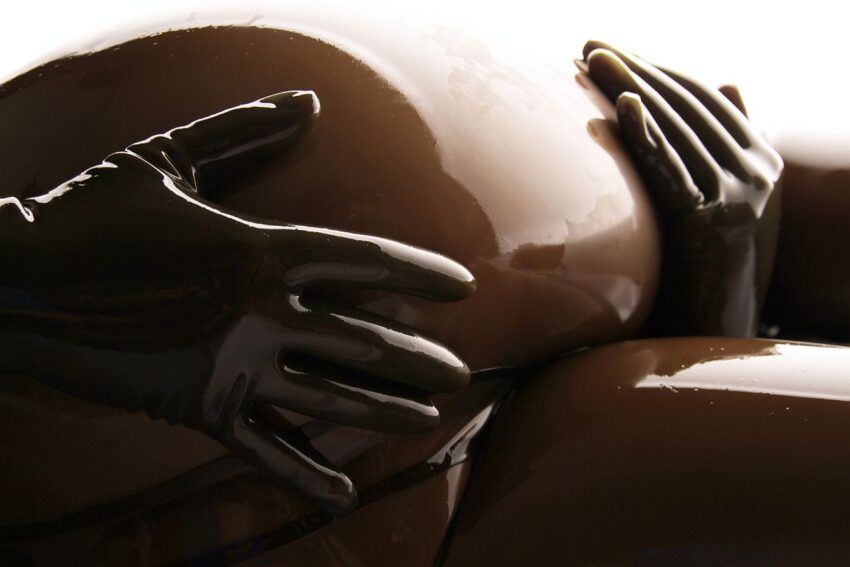
When the latex is covering the body it feels good for the skin underneath, but also for our hands gliding above. We can’t resist touching and feeling under palm and fingertip the perfect smoothness of its surface, so we stroke all parts of the rubber coated body, and this in turn amplifies the pressure already being felt under those areas.
You don’t need to be a fetishist to think wearing latex feels good; to think that it can be sensual and comforting. You just need to be receptive to the body’s largest sensory organ, the skin. And if “skin hunger” is the metaphor for craving touch sensation, then every so often we should spoil ourselves rotten and throw a decadent feast. Go on, you deserve it. Wear your latex.
Photography: agnadevi / Depositphotos