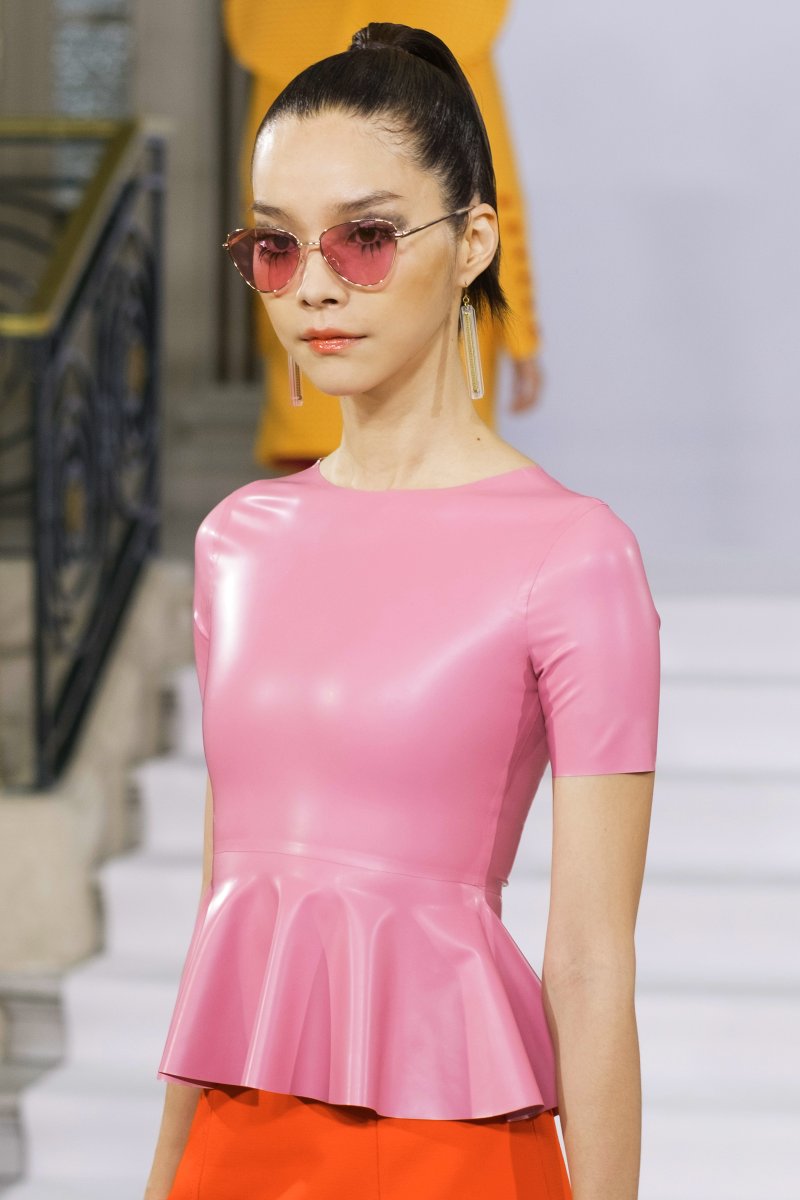
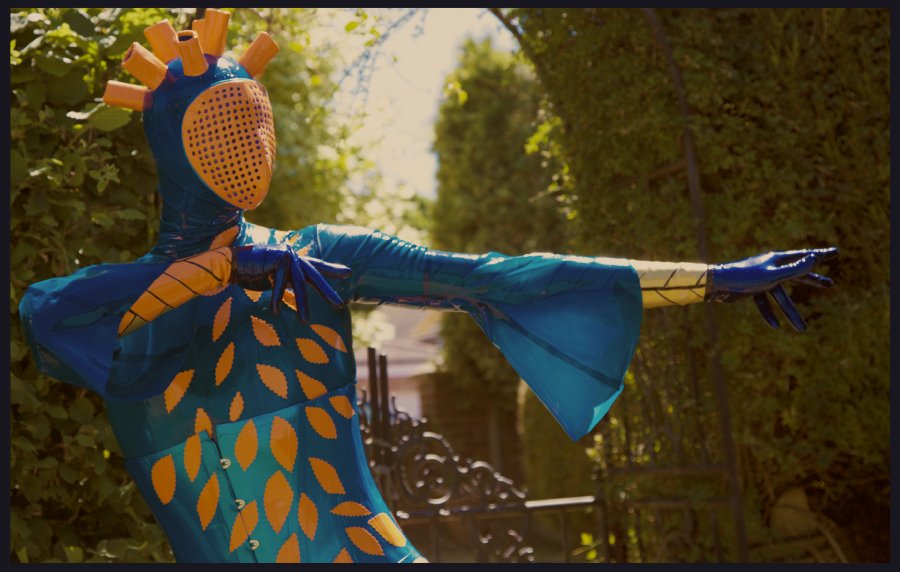
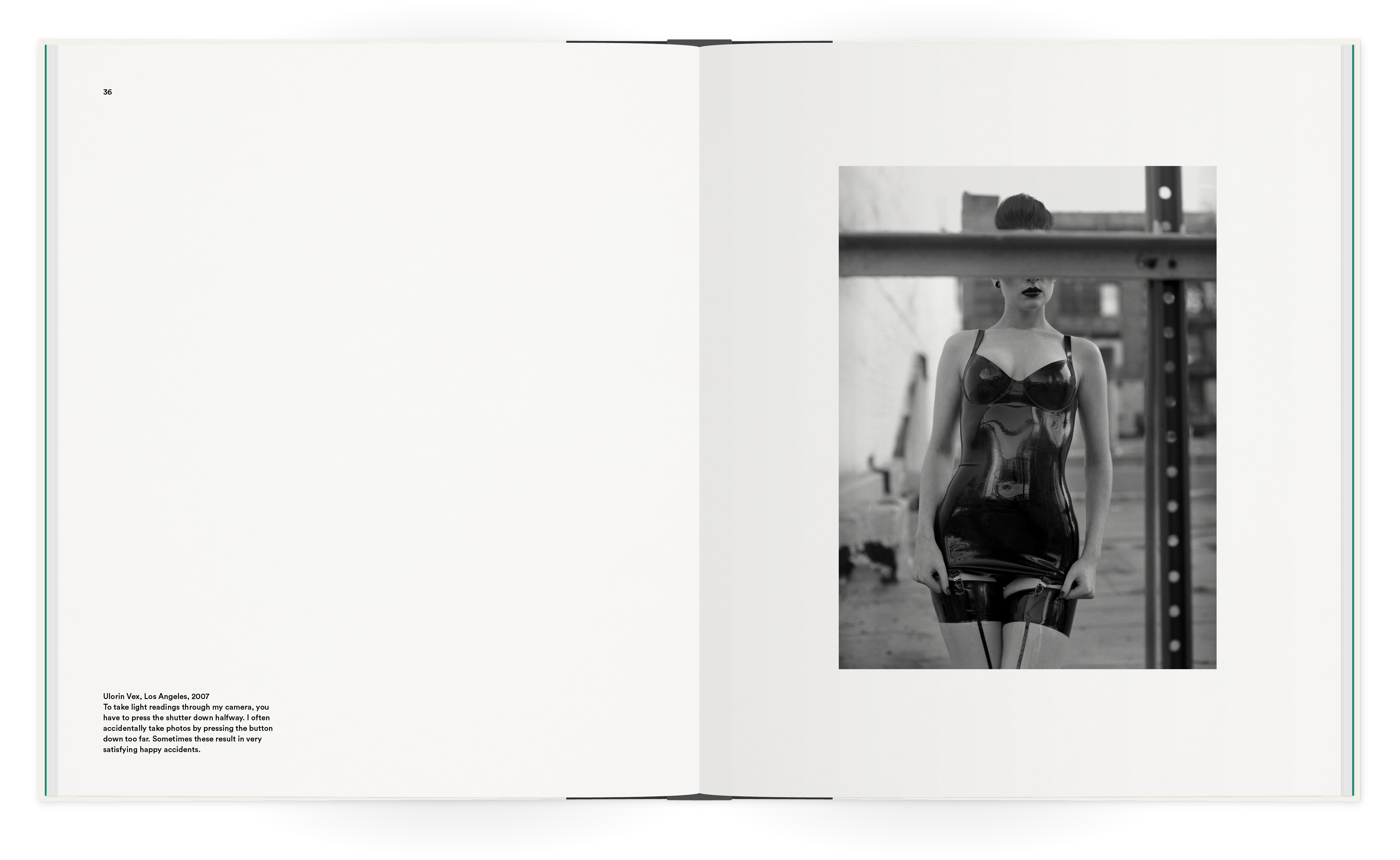
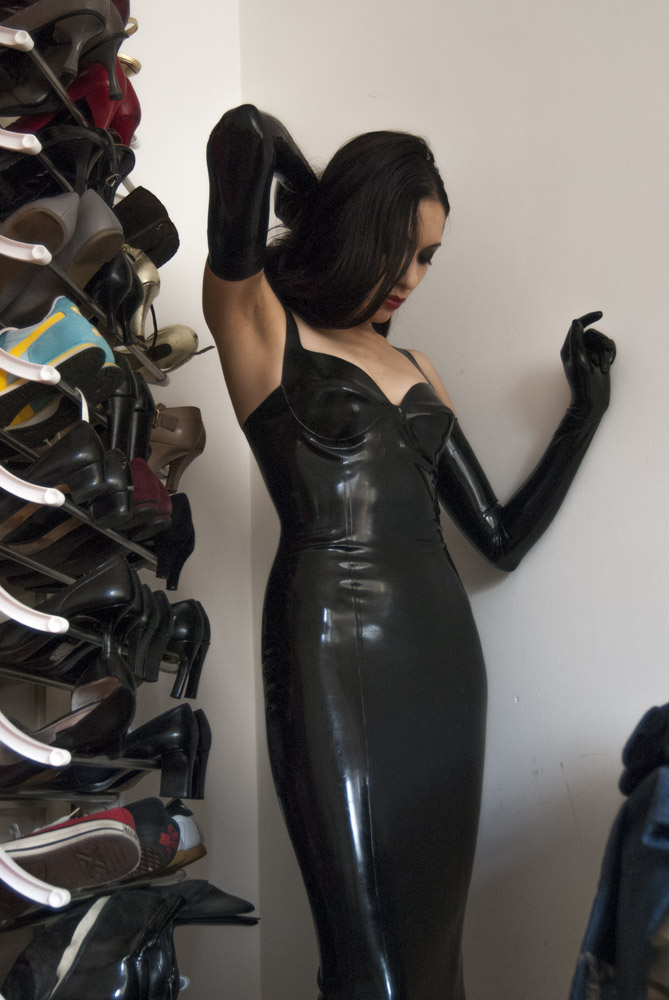
Heidi Patterson, a.k.a. Miss Fuzzy Bunny, was the designer behind the popular Etsy store Essential Latex. As the name might suggest, the store offered lots of foundation pieces for starting a latex wardrobe. The mix of fashionable, casual and familiar cuts and designs, combined with generous pricing, made for a latex store that was friendly to latex newbies and old hands alike.
This is Dark Shiny Fashion Alternatives’ seventh Q&A, and we thank them for sharing.
Can you provide a short bio of your background in fashion?
I was a fashion design student in the early ’80s in Boston, Massachusetts. I dropped out without a degree, but learned the basics of pattern design and construction, but never used it professionally. I sewed lots of my own clothes throughout the ’80s, then pretty much lost interest in the whole thing.
How did you discover latex as a material to use in fashion? Did you have a personal interest in wearing latex or was it just a material that you found interesting?
I was introduced to latex in 1987, and loved the tightness and how empowering it felt to wear. I never dreamed back then that I could actually make my own stuff, but in 2003 I met a Danish man who was making clothes with his friends and had a small label, NPNG, No Pain No Gain, and somehow the basics of fashion design kind of came back to me as I experimented and learned how to cut and glue latex.
At what point did you decide to take your personal interest in latex and transition it to a vocation?
Probably then, as I helped them with things such as fashion shows, and did the occasional order, and tried answering their customer emails, which were low on the priority list for the other 3. Then as I was contemplating a divorce and a move from Denmark around 2010, I started an Etsy store and started selling basics there and at the fetish shop, Latexa, where I worked.
A business has a number of things that one must deal with that sometimes dim one’s passion. You have rent, insurance, utilities, materials, employee salaries etc. Is the market for latex adequate to balance the pressures of business? What end of the market absorbs more time – the celebrity couture or the consumer market? How do you balance your passion for creativity with the need to be profitable?
Custom projects definitely absorbed more of my time and always took much longer than envisioned. In terms of hours worked, they ended up not really profitable for me.
What ultimately dimmed my passion was in 2013 I was diagnosed with breast cancer, while unemployed, and 1 month earlier being thrown out of my home by my husband. During treatment I had to ramp up the Etsy store, and many people came forward to order things from me as they knew of my struggle.
But once I had finished treatment in the ensuing years I experienced a lot of fear and paranoia about the carcinogenic properties of the glue and thinners, which really dimmed my passion and made it tough to get to the work table.
Latex can be described as a “fetish,” a “kink,”, “Alternative fashion” or simply “fashion”. Do you prefer one description over another?
Clothing would be my preference. And of course latex is also a fetish.
It seems many latex outfits are designed to be body hugging. I’ve heard latex referred to as a “second skin.” Do you agree that latex should be used for tight outfits or does it lend itself to “loose” outfits?
It’s awesome either way when done right.
If it’s a second skin, does it mean it needs to be worn without undergarments? Does that intimidate people from wearing it?
Not in my book, as an older woman who needs all the support she can get! It’s intimidating when others try to dictate to what’s true latex fetishism and what’s cheating. I know it prevents women from trying it when they’re told undergarments are a no-no, as I’ve seen it at the shop where I worked, and in the latex forums, of course.
In your experience, how concerned are people about body image when considering fashion choices? Does latex, as a material, help or hinder these decisions?
Tough question, I’ve seen both sides. For a lot of men, body image has nothing to do with wearing it because it’s a private fetish in the home. The body issue fears usually arise when people are going to a party, and worry that it’s not flattering. But there are also plenty of people in the scene who embrace the material and make real efforts to wear it regardless of their size.
Do you feel latex tends to express one’s body with honesty as if it was no different than a second skin, or is it more of a fashionable type of shapewear that fixes a person’s perceived flaws?
That depends entirely on the garment chosen. If it’s an out of the box moulded dress, it won’t eliminate body flaws or enhance a body unless the wearer has implants. If it’s a made to measure garment crafted by somebody who knows how to work with latex, it can definitely work as shapewear.
How do you find the market for latex wear distributed between men, women, cross-dressers (men or women), and celebrity couture?
There’s really not a lot of celebrity couture when you factor in every order I’ve done. For me orders leaned more toward women and crossdressers on Etsy, but that probably had a lot to do with my store and what garments I offered. Most of my custom work has always been for male clients.
What is your favorite piece of latex that you’ve created in your career, for a man and for a woman?
Probably some of the collaborative projects I did with my friend who has enormous style and always pushes the boundaries between fashionable male latex and fetish.
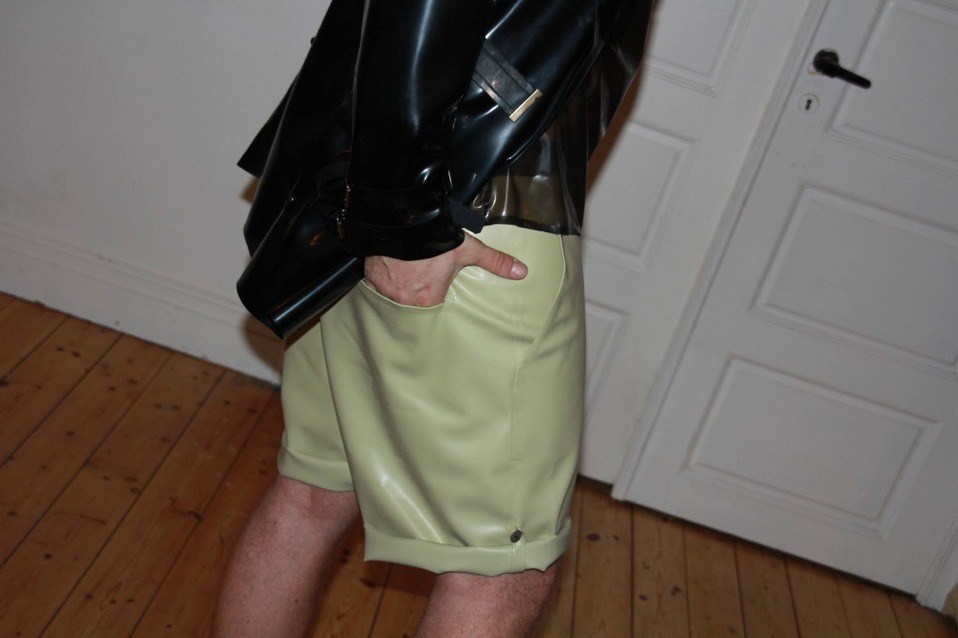
Two of the things I made were Macintoshes, one in black and one transparent, with a much greater level of detail than on the standard ones sold for men. There were D-rings below the belt loops, as is standard, real pockets, buttonholes, double collars. His Mao jacket was also heavy on detail, with an adjustable back belt, inner breast pocket, large pockets below, and modelled after a Pretty Green jacket, so the lines were more contemporary.
Likewise with casual shorts with inner buttons at the waist, deep side pockets and inner back pockets. The jeans were probably the coolest item simply because of the button fly, updated shaping, and full details.
Many of these can be seen on his Fetlife profile although his newer outfits are more fantasy styles with lots of advanced detailing, and were made by a local woman in Copenhagen, Nicolina.
People can state that they don’t like latex because of the smell, or because the material doesn’t breathe and they sweat to much, or because it’s too tight or it makes them look like they’re selling sex. How do you address those concerns?
Try to show them examples of people enjoying the clothing. Often just trying it on eliminates these former concerns. Seeing is believing.
What is your design philosophy? What drives your creativity?
I don’t really design these days. I liked making latex that wasn’t too corny or cheesy, or excessively designed with far too many design elements going on in one garment. Restraint and elegance I suppose would have been my philosophy.
Less or More? Do you prefer designing a latex outfit which is more on the revealing side or leaning towards full coverage?
More…. such as ’50’s style dresses, or long sleeved blouses.
How do you feel is the best way to integrate latex into an everyday “public” outfit. How would you mix it with other materials?
I’d wear leggings with a sweater or tunic, perhaps, or a blouse in conventional fabric with a latex pencil skirt or wide legged latex trousers. My jabot blouse in .25 gauge latex was always a nice public touch, because one normally doesn’t associate gathers with latex.
Stine Hjelm Jacobsen of Electric Lady Lab worked with Heidi a number of times, including for the music video for “Wondering”.
What are your goals for your future in latex design?
I’ve stopped doing latex, mainly because I lack the passion to work as hard at it as I know I would need to in order to be successful.
What is your favorite part of being a latex fashion designer?
I loved making things which enhanced the beauty of my customers and made them happy.
What is your blue sky accomplishment to achieve in the world of latex clothing or fashion in general?
I would have loved to achieve more prominence and worked with more celebrities, but I don’t think I ever had the drive or creativity, to be honest.
Latex fashion seems to be a small subset of the fetish world. It rarely has it’s own forum and must latch onto other fetish and BDSM events. If you are not into BDSM or “play parties” it can seem a rather lonely interest. What are your thoughts on being able to showcase latex interest without having to participate in the fetish/BDSM “scene”?
I think it used to be much easier when there were more events like Rubber Cult, and when there were bigger headline events and balls where people would travel. Lately the latter seem to have died down somewhat. The best part of these events has always been to mix and meet people from online, and add them to my worldwide group of friends. Play never had much of a priority, to be honest, as one can play anywhere. Finding the right venue and mix of people, however, is harder.
You note that most of your custom work was for male clients. You also note that properly tailored latex is a must. So what kind of outfits did you create? James Bond in latex or Rue Paul in latex?
Mostly James Bond was what my clients wanted, or simply put: casual styles in modern cuts, such as lower waisted jeans, as opposed to high waist jeans with much too wide legs, which other manufacturers stick too, and end up looking very dated.
FDR stated that “We have nothing to fear but fear itself.” People tend to be fearful of things that are different. They express that fear through aggressive or demeaning behavior towards others to express that their position is superior. Even without external pressure, a person can be fearful due to internal thoughts over how people will react.
This brings us to fashion. You can say the more different a style is from the norm, the more people will react negatively.
Do you agree with this? Is latex too different from accepted fashion to be commonplace? How much more extreme is it than wearing leather? Women often wear leather to corporate jobs. Is latex that much more extreme? Is men’s latex wear more “extreme” than women’s wear?
What do you say to someone who deep down would want to wear latex in public settings?
I think it depends on the context. People can be very conservative and yes, anything different can be objectionable. If the wearer acts confident it tends to be easier to get away with latex in public.
Wearing latex to the office is probably not appropriate, unless you work in an art gallery or something.
Men’s latex in public needn’t be more extreme than a woman’s choices, it depends on the garment. I am very opposed to wearing anything overtly sexual or revealing in a public arena simply because of the issues of consent. It’s impolite to impose a penis sheathed catsuit or leggings on the unsuspecting. A latex t-shirt, on the other hand, should be just fine.
Women’s clothing seems to have such variety. Can men’s latex be as interesting? What are your thoughts on men’s latex fashion?
Absolutely! I am also a strong believer in properly tailored menswear.
Is there anything you would like to add?
Follow the forums and be open to new ideas and new talent, from models to designers. It’s so sad to me to see people in the forums who still cite models who are by now inactive, or list blogs which have long since stopped updating, while overlooking the newcomers and what they offer. Also, don’t take yourself too seriously, or fall down the rabbit hole and let latex consume you.

Thank you to Heidi for her participation, and to Kyle&Selina of the Dark Shiny Fashion Alternatives blog for holding the Q&A.
Links:
Previous Q&As: